

Info Center
Press Releases
 Share
Share
-
 Facebook
-
 LinkedIn
-
 WhatsApp
-
 Email
Email
-
 Copy Address
URL copied!
Copy Address
URL copied! -
 Print This Page
MPFA Chairman’s Blog - MPF – effective retirement protection
MPFA Chairman Mrs Ayesha Macpherson Lau published her blog post today (30 August), noting that MPF, together with various supports available under Hong Kong’s multi-pillar retirement protection framework such as public healthcare, public/subsidized housing, and public transport fare concession and social security allowance for the elderlies, can complement one another in providing adequate basic retirement protection for employees. The blog post cited a few projection scenarios to demonstrate that the earlier an employee starts retirement savings, the greater the accumulating and compounding effect achieved.
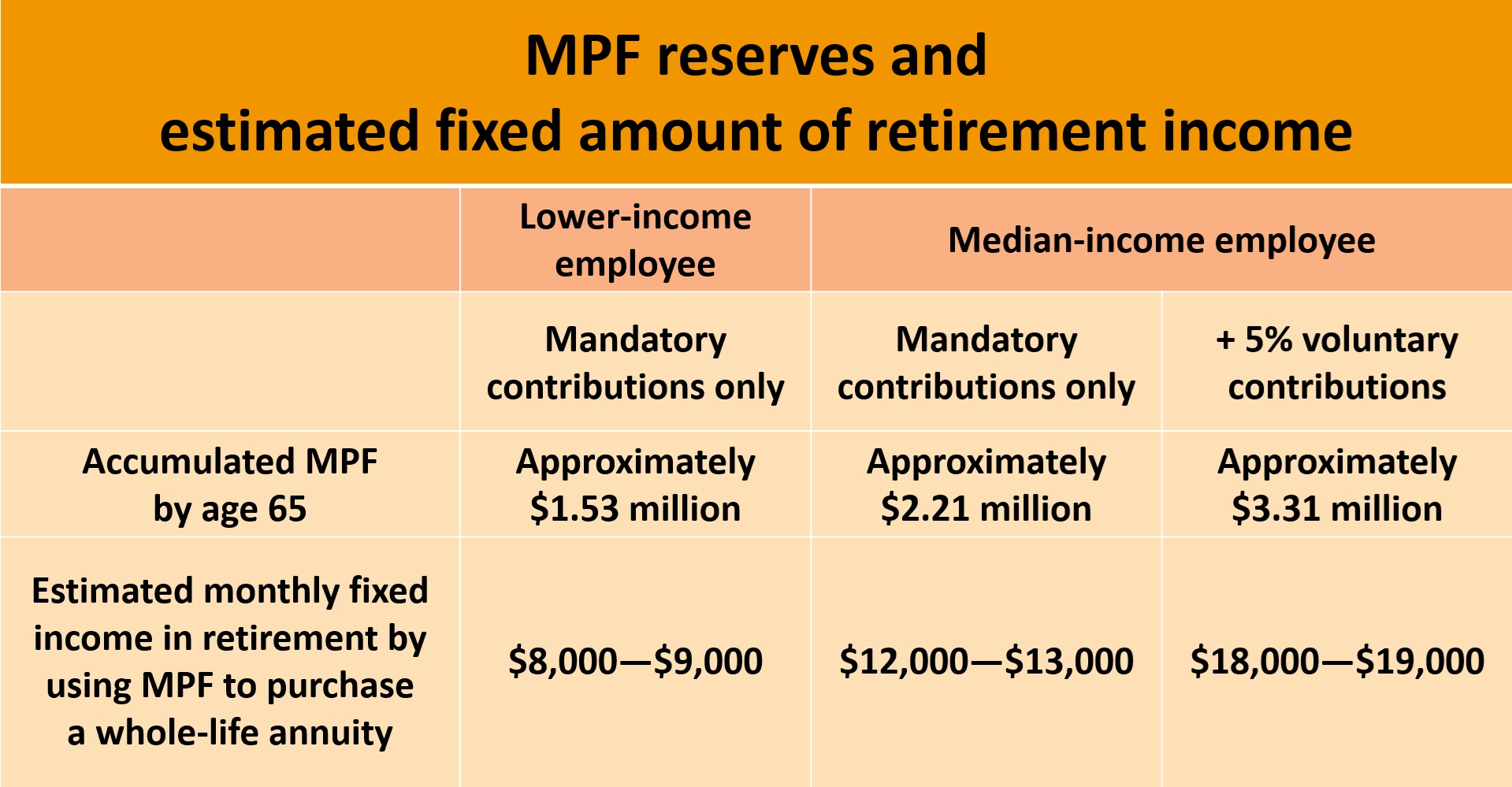
She used an example of a lower-income employee who entered the workforce at the inception of the MPF System in 2000 and is now in his/her 40s (assuming that throughout his/her career, this employee’s income has remained at the 25th percentile employment earnings distribution and his/her current monthly income is approximately $15,000). If the lower-income employee initially invested in mixed assets funds and then switched to the default investment strategy (DIS) when the latter was launched in 2017, projections indicate that this employee could accumulate approximately $1.53 million in MPF by age 65 through mandatory contributions alone.
Taking a median-income employee who also entered the workforce in 2000 as another example (assuming that throughout his/her career, this employee’s income has remained consistent with the median income of the corresponding age group and his/her current monthly income is approximately $22,000), and using the same set of investment assumptions above, projections indicate that this median-income employee could accumulate approximately $2.21 million in MPF by age 65 through mandatory contributions alone.
If this median-income employee has also been making voluntary contributions in the past (equivalent to 5% of monthly income) and continues to make both mandatory and voluntary contributions in the future (assuming the contribution ratios remain unchanged), projections show that his/her accumulated MPF at age 65 would increase to approximately $3.31 million. This is about 50% more than the projected MPF of a median-income employee of the same age who makes only mandatory contributions. This demonstrates that making good use of voluntary contributions is an effective way to build up retirement reserves.
Mrs Lau added that these projections demonstrate that a lower-income employee, through 40 years of persistent contributions and value growth through investment, could accumulate approximately $1.53 million in retirement savings from MPF mandatory contributions alone. If this scheme member makes good use of retirement reserves and purchases a whole-life annuity after retirement, he/she could receive a fixed amount of monthly income of $8,000 to $9,000. For the median-income employee, MPF mandatory contributions alone could result in retirement savings of about $2.21 million. If this employee also purchases a whole-life annuity upon retirement, he/she could receive a fixed amount of monthly income of $12,000 to $13,000. Alternatively, if a scheme member chooses not to purchase annuity, he/she may consider withdrawing a certain percentage of retirement reserves each year to meet daily living expenses, while keeping the remaining balance invested through MPF Retirement Solutions. This retirement protection accumulated through MPF mandatory contributions would be sufficient to cover basic living expenses in retirement.
For the median-income employee mentioned above, if voluntary contributions are added, his/her MPF could grow to approximately $3.31 million by age 65. This scheme member could receive a fixed amount of monthly income of $18,000 to $19,000 in retirement if he/she purchases a whole-life annuity.
The examples above underscore the importance of supplementary savings, including MPF voluntary contributions, for employees who aspire to a more comfortable retirement. It also demonstrates that the earlier scheme members start making voluntary contributions, the more they stand to benefit from the powerful effects of long-term accumulation and compounding, Mrs Lau added.
Mrs Lau further said that some employees feel that they do not have the time or sufficient knowledge to manage their MPF investments. In response, MPFA launched DIS in 2017 to serve as a choice for these employees. Since its launch, the investment return of DIS has been impressive. The Core Accumulation Fund under DIS has achieved an average annualized net return (net of fees) of 7.3%, far exceeding the annualized inflation rate of 1.8% over the same period, thereby enabling long-term value growth in MPF.
For the full version of the article, please visit the MPFA blog. The blog is available in Chinese only.
-Ends-
30 August 2026